WASHINGTON D.C.
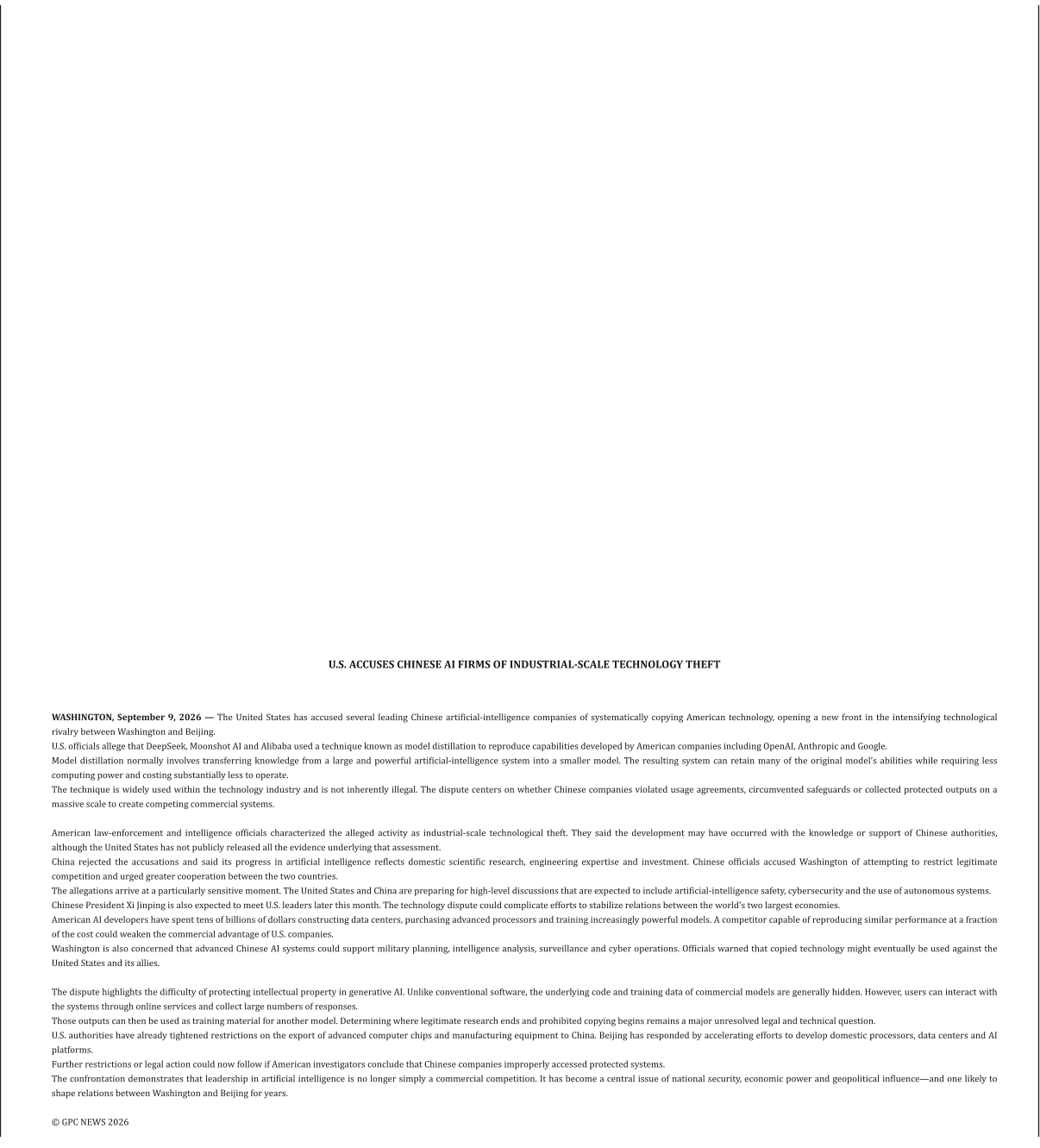
Global Press Connect provides independent news and analysis on international  politics, the economy, and humanitarian developments. © 2026 GlobalPressConnect | GPC.NEWS Founded and operated by Simone Mayer & Helping Hands for Children Foundation Inc. | Los Angeles, California, USA GlobalPressConnect (GPC.NEWS) is an independent international news organization dedicated to delivering accurate, impartial, and timely journalism. Our mission is to provide verified reporting, editorial integrity, and in-depth coverage of global affairs, politics, business, financial markets, technology & AI, entertainment, humanitarian issues, weather, and breaking news. All Rights Reserved. U.S. ACCUSES CHINESE AI FIRMS OF INDUSTRIAL-SCALE TECHNOLOGY THEFT    WASHINGTON, September 9, 2026 — The United States has accused several leading Chinese artificial-intelligence companies of systematically copying American technology, opening a new front in the intensifying technological rivalry between Washington and Beijing. U.S. officials allege that DeepSeek, Moonshot AI and Alibaba used a technique known as model distillation to reproduce capabilities developed by American companies including OpenAI, Anthropic and Google. Model distillation normally involves transferring knowledge from a large and powerful artificial-intelligence system into a smaller model. The resulting system can retain many of the original model’s abilities while requiring less computing power and costing substantially less to operate. The technique is widely used within the technology industry and is not inherently illegal. The dispute centers on whether Chinese companies violated usage agreements, circumvented safeguards or collected protected outputs on a massive scale to create competing commercial systems.  American law-enforcement and intelligence officials characterized the alleged activity as industrial-scale technological theft. They said the development may have occurred with the knowledge or support of Chinese authorities, although the United States has not publicly released all the evidence underlying that assessment. China rejected the accusations and said its progress in artificial intelligence reflects domestic scientific research, engineering expertise and investment. Chinese officials accused Washington of attempting to restrict legitimate competition and urged greater cooperation between the two countries. The allegations arrive at a particularly sensitive moment. The United States and China are preparing for high-level discussions that are expected to include artificial-intelligence safety, cybersecurity and the use of autonomous systems. Chinese President Xi Jinping is also expected to meet U.S. leaders later this month. The technology dispute could complicate efforts to stabilize relations between the world’s two largest economies. American AI developers have spent tens of billions of dollars constructing data centers, purchasing advanced processors and training increasingly powerful models. A competitor capable of reproducing similar performance at a fraction of the cost could weaken the commercial advantage of U.S. companies. Washington is also concerned that advanced Chinese AI systems could support military planning, intelligence analysis, surveillance and cyber operations. Officials warned that copied technology might eventually be used against the United States and its allies.  The dispute highlights the difficulty of protecting intellectual property in generative AI. Unlike conventional software, the underlying code and training data of commercial models are generally hidden. However, users can interact with the systems through online services and collect large numbers of responses. Those outputs can then be used as training material for another model. Determining where legitimate research ends and prohibited copying begins remains a major unresolved legal and technical question. U.S. authorities have already tightened restrictions on the export of advanced computer chips and manufacturing equipment to China. Beijing has responded by accelerating efforts to develop domestic processors, data centers and AI platforms. Further restrictions or legal action could now follow if American investigators conclude that Chinese companies improperly accessed protected systems. The confrontation demonstrates that leadership in artificial intelligence is no longer simply a commercial competition. It has become a central issue of national security, economic power and geopolitical influence—and one likely to shape relations between Washington and Beijing for years.  © GPC NEWS 2026
TECH / AI